
There is a particular kind of stillness that comes when you sit down with a well-made photo book. You are not scrolling. You are not swiping. You are not half-distracted by a notification pulling your attention sideways. You are simply present with images, turning pages slowly, letting one photograph lead you to the next, feeling the weight of the book in your hands and the texture of the paper under your fingers. That experience is increasingly rare in a world where most photographs live and die on a screen, viewed for a fraction of a second before the feed moves on. Photography photo books are the antidote to that disposability. They are how photographs become permanent, how moments become memories with physical form, and how the art of photography finds its most complete and dignified expression. Understanding what they are, what they can be, and why they matter is understanding something important about photography itself and about the human need to hold onto the things that matter most.
What Photography Photo Books Actually Are
A photography photo book is a bound, printed collection of photographs presented as a cohesive physical object. That definition sounds simple, but it encompasses an enormous range of forms, purposes, and levels of ambition. At one end of the spectrum, a photography photo book might be a personal keepsake created through an online service, collecting family holiday snapshots into a printed album that sits on a coffee table and gets pulled out at Christmas. At the other end, it might be a museum-quality fine art publication printed on archival cotton rag paper, sequenced and designed with the precision of a curator, and sold in gallery bookshops alongside established names in the history of photography.
What unites every point on that spectrum is the fundamental act of giving photographs a permanent physical home. Photography photo books transform images from digital files, from electrons arranged on a hard drive or pixels illuminated on a screen, into something you can hold, share, lend, pass down, and return to across years and decades. This transformation is not merely practical. It is philosophical. It is a statement about which images matter enough to be made permanent, which moments deserve to be curated rather than simply stored, and which experiences are worth translating from the transience of the screen into the durability of print.
The history of photography photo books runs parallel to the history of photography itself. Early photographers understood intuitively that the printed book was the natural home for photographic sequences and series. William Henry Fox Talbot’s “The Pencil of Nature,” published in installments between 1844 and 1846, is generally considered the first commercially published book illustrated with photographs. It established a tradition that has continued unbroken through Edward Steichen’s “The Family of Man,” Robert Frank’s “The Americans,” and into the present day, where photography photo books remain one of the most vital and actively evolving forms within contemporary photography culture.
The Different Categories of Photography Photo Books
Photography photo books exist in several distinct categories, each with its own conventions, audiences, and purposes. Understanding these categories helps clarify what a photography photo book can be and what different creators and audiences are looking for from the form.
Fine art photography books are created by photographers whose work is recognized within the art world and who intend their books as artistic statements equivalent in seriousness to an exhibition or a portfolio of prints. These books are typically produced in limited editions, often with the involvement of specialist publishers or the photographers themselves, and they are collected by photography enthusiasts, art libraries, and institutions. They command significant prices and are designed with exceptional attention to every production detail. The sequence of images, the choice of paper, the typography, the binding, and even the dimensions of the book are all chosen in service of the artistic vision.
Documentary and photojournalism books collect and present work created in the tradition of concerned photography, images that bear witness to events, conditions, and communities that the photographer believes the world needs to understand. These books serve a dual purpose: they function as artistic objects and as historical records. Books like Sebastião Salgado’s “Workers” or James Nachtwey’s “Inferno” are both powerful photographic experiences and essential documents of the human realities they depict. The photography photo book format gives this work a permanence and an accessibility that exhibition alone cannot provide.
Commercial and client photography books include wedding albums, portrait collections, travel books, and other forms created in a professional photography context as deliverables for paying clients. These books represent the largest volume of photography photo book production and the most direct connection between the form and everyday life. A wedding photographer who delivers a beautifully crafted album is giving their clients something that will outlast every digital file and every social media post. These books are the ones most likely to be pulled off the shelf in fifty years by people who were not yet born when the photographs were taken.
Why Photography Photo Books Matter More Than Ever
The importance of photography photo books has not diminished in the digital age. If anything, it has grown. The proliferation of digital photography has created a paradox: we take more photographs than at any point in human history, and we preserve fewer of them in any form that will last. The average smartphone contains thousands of photographs, most of which will never be printed, never be organized, and never be seen again after the moment they were taken. Hard drives fail. Cloud services shut down. Digital formats become obsolete. The photographs that exist only as digital files are far more fragile than they appear.
Photography photo books represent the most reliable form of photographic preservation available to individuals and families. A well-produced photo book, printed on quality paper with archival inks and properly stored, will remain readable and beautiful for a century or more. The photographs inside it will not degrade with repeated viewing the way digital files degrade when storage media fails. They will not disappear when a subscription lapses or a platform closes. They will not require any technology to access beyond eyes and hands. This durability is not a trivial advantage. It is the difference between memories that persist across generations and memories that vanish when a device becomes obsolete.
The Emotional Weight of a Physical Photograph
There is substantial research in cognitive psychology and memory science supporting what many people know intuitively: physical photographs create stronger emotional connections and more durable memories than digital images viewed on screens. Studies by researchers at the Hewlett Packard Memory Lab and by cognitive scientist Dr. Linda Henkel at Fairfield University have found that the physical act of holding and interacting with printed photographs enhances the emotional salience of the memories associated with them and increases the likelihood that those memories will be retained over time.
This phenomenon has a neurological basis. Physical objects engage multiple sensory systems simultaneously. When you hold a photography photo book, you are engaging your tactile sense through the texture of the paper and the weight of the book, your visual sense through the printed images, and your proprioceptive sense through the physical act of turning pages. This multi-sensory engagement creates richer neural encoding of the experience than the purely visual engagement of screen viewing, which may partly explain why printed photographs so consistently feel more emotionally significant than their digital equivalents.
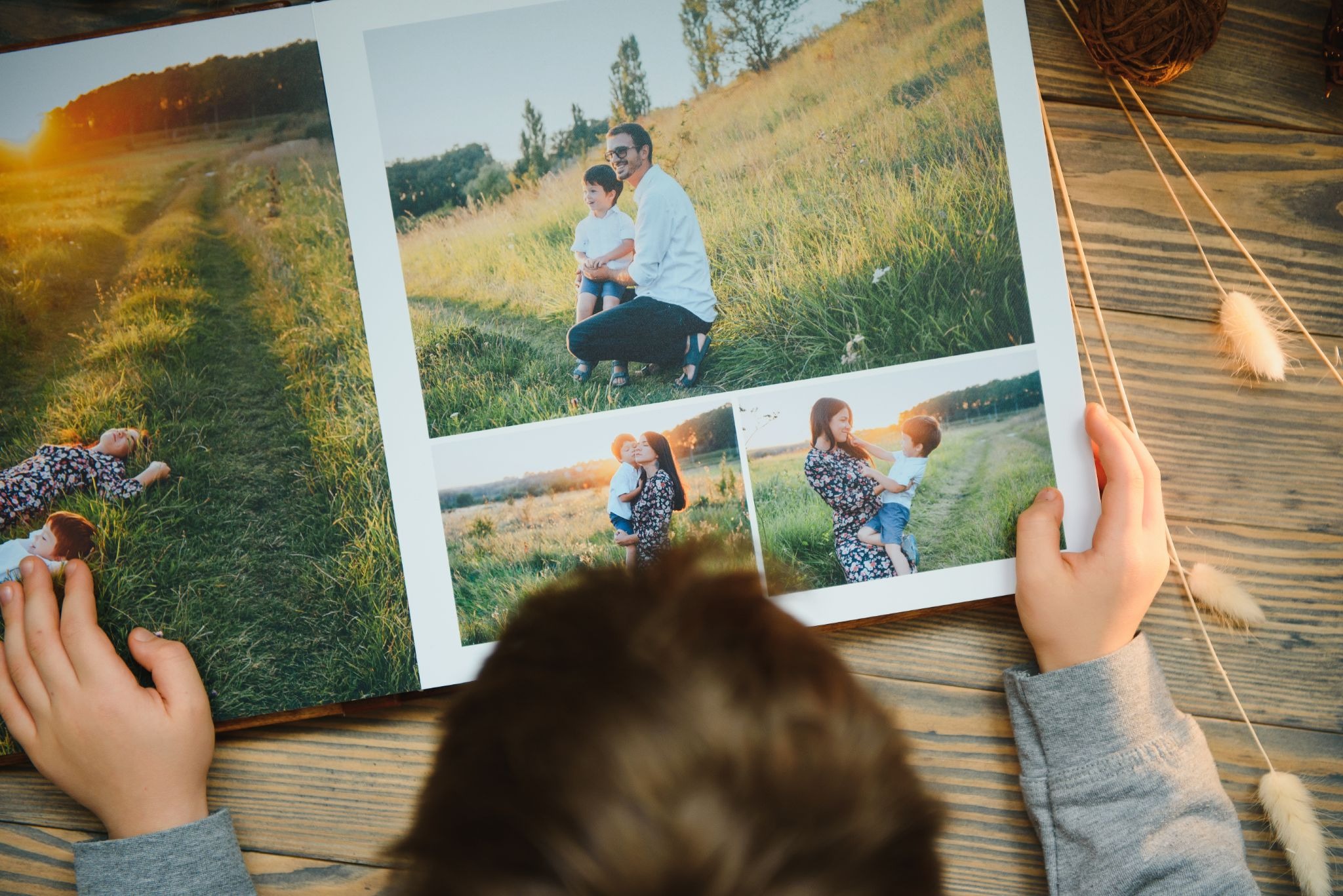
The emotional weight of a physical photograph also has a social dimension. Photography photo books are objects that can be shared in a fundamentally different way than digital images. You can sit with someone and look through a photo book together. You can hand it across a table and watch someone’s face as they turn the pages. You can leave it somewhere for someone to find. These social rituals of physical image sharing are entirely absent from digital photo sharing, which is always mediated by a screen and always experienced in relative isolation even when it is technically simultaneous.
Photography Photo Books as Cultural and Historical Records
Beyond their personal and emotional significance, photography photo books serve an important function as cultural and historical records. The history of the twentieth century would be significantly less understood without the photography photo books that documented it. Dorothea Lange’s Depression-era images, published in “An American Exodus,” gave the suffering of the Dust Bowl migrants a visual reality that shaped public understanding and political response. Robert Capa’s war photography, collected in numerous books, created a visual vocabulary for understanding armed conflict that influenced how generations of people thought about war.
The Artistic Significance of Photography Photo Books
Within photography as an art form, the photo book holds a distinctive and irreplaceable position. Many photographers consider the book to be the primary medium for their work, more important even than the exhibition print, because of the sequential and narrative possibilities it offers and because of its accessibility to a broad audience. A gallery exhibition is experienced by however many people visit that gallery during the exhibition’s run. A photography photo book can be experienced by anyone, anywhere, at any time, for as long as copies exist.
The sequence is the great artistic possibility that photography photo books offer that no other format can match. A single photograph communicates through composition, light, subject, and moment. A sequence of photographs communicates through all of these and through the relationships between them, the way one image prepares the viewer for the next, the way visual rhymes and contrasts create meaning that no individual image could generate alone, the way pacing and rhythm shape the emotional experience of moving through the work. The best photography photo books are not collections of great photographs. They are works in which the sequence itself is the primary creative achievement.
How Sequencing Creates Meaning Beyond Individual Images
The power of sequencing in photography photo books is demonstrated most clearly by considering what happens when the same images are arranged differently. Robert Frank made approximately 28,000 exposures during the road trip that became “The Americans.” From those exposures, he selected 83 images and arranged them in a specific sequence that created a particular vision of America, its loneliness, its contradictions, its beauty, and its darkness. The same 83 images arranged differently would have been a different book with a different meaning. The sequence was not just the organization of the content. It was the content.
This understanding of sequencing as meaning-making has profound implications for how photographers approach the creation of photography photo books. It means that the selection and arrangement of images is not a secondary task that follows the real work of taking photographs. It is itself a primary creative act that requires as much skill, intuition, and craft as the photography itself. Photographers who approach photo book creation with this understanding consistently produce more powerful and coherent work than those who treat sequencing as a matter of simple chronology or thematic grouping.
The Photo Book as a Democratic Art Form
One of the most significant qualities of the photography photo book as an artistic form is its democratic accessibility compared to other forms of art distribution. Original photographic prints can command prices that place them beyond the reach of most art enthusiasts. Gallery exhibitions are geographically limited and temporally brief. But photography photo books, even those produced in limited editions, circulate through libraries, second-hand bookshops, and online marketplaces in ways that make important photographic work accessible to people who could never afford to own an original print or travel to a gallery showing the work.
The Resurgence of Photography Photo Books in the Digital Age
Far from being rendered obsolete by digital photography and digital distribution, the photography photo book has experienced a remarkable resurgence in the past decade. Independent photography publishers have multiplied. Photo book fairs, most notably the New York Art Book Fair and Paris Photo’s Offprint fair, draw tens of thousands of visitors annually. Photographers at every level of their careers are choosing to self-publish photo books as a way of giving physical form to their work and reaching audiences in a way that online portfolios and social media cannot replicate.
This resurgence is partly a reaction to digital saturation. In a world where photographs exist in almost incomprehensible quantities online, the physical photo book represents scarcity, permanence, and intention. It says that these images were selected carefully, that they were considered important enough to print, and that the creator believed they deserved to exist as a physical object rather than simply as pixels on a server. This intentionality has a powerful appeal in a cultural moment defined by the flood of unedited, unconsidered digital imagery.
The Independent Photo Book Scene and Its Influence
The independent photography photo book scene, centered around small publishers, self-publishing photographers, and specialist bookshops, has become one of the most vital and innovative areas of contemporary photography culture. Publishers like MACK, Aperture, Loose Joints, and dozens of smaller operations are producing photo books that push the boundaries of what the form can be, experimenting with unusual formats, materials, and structures that challenge conventional assumptions about what a photography book looks like and how it is experienced.
Final Thought
Photography photo books are not nostalgic objects clinging to relevance in a digital world. They are the fullest expression of what photography can be when it is treated with the seriousness and the care it deserves. They are how photographs become permanent, how moments become narratives, and how the art of seeing gets shared across time and space in a form that no screen can replicate. In a world drowning in images, a photography photo book is an act of conviction. It says that these images matter enough to be made real, to be given weight and texture and permanence. That conviction is precisely what makes them so important, and precisely why the best ones are worth creating, collecting, and returning to for the rest of your life.